Creating Realistic Virtual Populations Without Privacy Risks
The Synthetic Population Generator creates realistic virtual individuals that represent the actual population of London boroughs. Each synthetic person has a complete profile including demographics, location, income, housing situation, and employment status.
Synthetic population generation involves creating artificial datasets that mimic real-world demographics without compromising individual privacy. This technique is crucial for researchers and policymakers who require detailed population data for simulations and analyses.
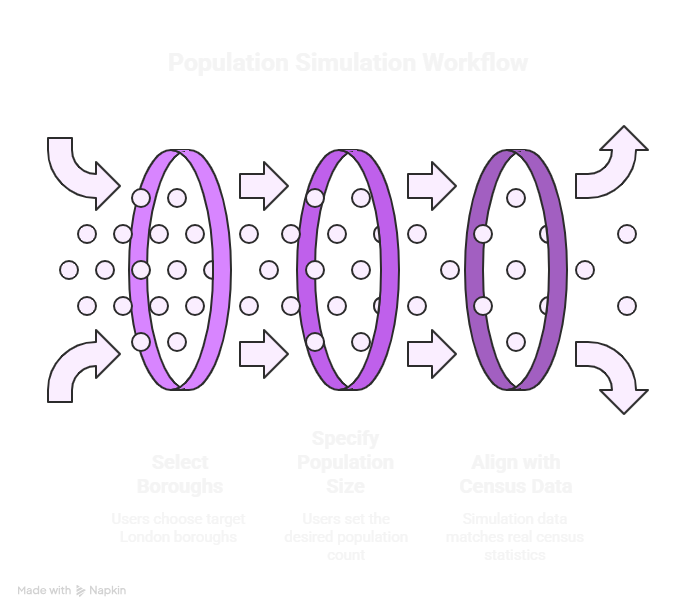
Generation Workflow
Customers' Journeys
User selects target borough(s)
Camden, Westminster, Hackney, or any London borough
User specifies population size
E.g., 10,000 individuals for Camden
System generates individuals
With realistic, correlated attributes
Population is validated
Against real census data for statistical accuracy
Generated Attributes
Attribute Details
Attribute Details
Age
18–90, distributed to match real population curves
Gender
Male / Female, matching borough ratios
Ethnicity
Reflecting actual borough diversity profiles
Annual Income
£15,000 – £150,000+, correlated with employment and education
Realistic postcode assignment within the selected borough
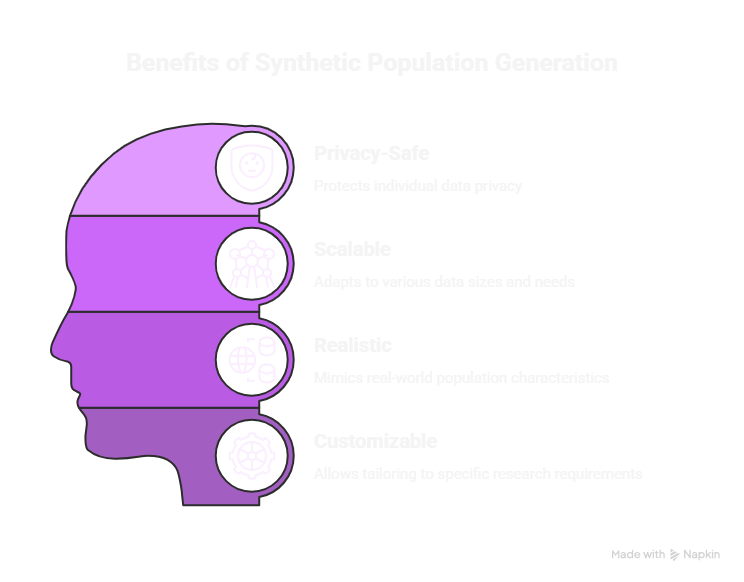
Key Benefits
How is it helping?
Privacy-Safe
Scalable
Realistic
Customizable
Need Help?We’ve Got Answers
The tool is currently optimized for Greater London, allowing you to select and synthesize data for specific boroughs such as Camden, Westminster, or Hackney. You can generate a custom population size (e.g., 10,000 individuals) for a single borough or a combination of multiple areas to study cross-border trends.
Rather than just matching total numbers, the system ensures that individual attributes—like age, income, and employment—are logically linked based on real-world patterns. For example, the generation workflow uses AI to ensure a "retired" individual is not also assigned a "student" status, maintaining the structural integrity of the household data.
After the initial generation, the system uses IPF to validate the artificial population against official census and administrative records. This mathematical step ensures that the synthetic "marginals" (the summary totals for things like ethnicity or housing type) align perfectly with real-world data, guaranteeing that the model is a high-fidelity mirror of the actual population.
Yes. The platform is specifically designed to support infrastructure planning, such as forecasting Electric Vehicle (EV) adoption. By simulating how different households within a borough might adopt new technology based on their synthetic profiles, planners can determine exactly where to place charging stations or how to allocate energy resources.
Yes. Because synthetic populations are comprised of entirely artificial records with no one-to-one link to real people, they are considered "anonymous information" under GDPR. This allows researchers and planners to analyze sensitive demographic patterns and test policies without the legal risks or bureaucratic hurdles associated with processing Personal Identifiable Information (PII).